
FROM THE BUCKET REVIEWS ARCHIVE
SDAFF 2011: Aftershock, Don’t Go Breaking My Heart, & Norwegian Wood
Danny Baldwin · October 25, 2011
 I’m already deep into this year’s San Diego Asian Film Festival and the reviews are stacking up. While I haven’t seen anything great just yet, the movies have been good on the whole and the festival has been running very smoothly. Those in the know weren’t lying when they told me that this was the city’s preeminent film gathering. My only complaint thus far has been the marginal projection — the shutter-timing and focus on the 35mm setup in the main house could use adjustment, and one of the two digital presentations I have seen thus far came from a lackluster DVD source. It’s sad that exceptional picture and sound have become the domain of only the most artistically flourishing cities — New York, Los Angeles, San Francisco, and a handful of others.

The aftermath of cinema's shortest, but most devastating earthquake in Xiaogang Feng’s Aftershock.
You may be aware of Xiaogang Feng’s Aftershock; not only is it the highest grossing film of all-time in China, it also received a theatrical release in a couple dozen cities last year. I missed the movie when it ran at the local AMC La Jolla 12, so I was excited to see what I assumed to be a big-budget disaster epic on the silver-screen.
To my surprise, there is actually very little action in Aftershock; after the central disaster (the Tangshan Earthquake of 1976) rocks the screen for about as little time as it did in real life (23 seconds), the film becomes a character study. That would be just fine by me, if not for the fact that it’s not a very good character study — the script is one-dimensional and one gets the feeling that the only way the film could be enjoyed is as a product of Chinese nationalism. In fact, if I had to compare Aftershock to another movie, it would be Pearl Harbor… only the disaster comes at the beginning rather than the end. As was the case with that Michael Bay box office hit, Xiaogang’s film proves that you can make dialogue-driven, human drama just as inert and boring as action spectacle.
Even during the earthquake, the focus is on one family. The father (Zhang Guoquiang) dies trying to rescue his children, and his wife (Xu Fan) must then decide whether to save their son or their daughter, because lifting the piece of rubble will not only unearth one, but crush the other to death. (And you thought the narrative gimmicks of American blockbusters were bone-headed?) Little does she know, however, her daughter (played as an adult by Chen Li) actually survives, and lives out her life with an adoptive family. Even though a reunion is inevitable, director Xiaogang milks the story for over two hours, observing son and daughter lead their separate lives over 20 years. Despite the volume of material, the character development is narrowly more complex than that of your average soap opera.
The most interesting aspect of the film is how Western it is, despite its appearance as an artifact of Chinese pride. Not only does Aftershock feel like the work of a Hollywood director–I didn’t make the Michael Bay comparison in jest–but it is aware, if not actively critical, of Chinese social mores. Namely, the film confronts head-on the valuing of males over females in China and even tackles hot-button social issues, such as abortion. Xiaogang and writer Wu Si don’t have much interesting to say in these respects, so they don’t ultimately enrich the film, but they do perhaps signal an emerging voice of resistance in mainstream Chinese cinema. Just as the melodramas of Douglas Sirk snuck radical social commentary past the Hollywood Production Code of the 1950s, Aftershock seems to be hitting at topical Chinese issues within a blockbuster that otherwise could have been produced by the Communist government itself.
Still, without compelling action or character drama, Aftershock is essentially a worthless movie on the merits. English-speaking viewers will admittedly have a ball watching the one Anglo character, who awkwardly speaks (perhaps intentionally) as if he is a Chinese native who just learned the language, but his five minutes are hardly enough to save the rest. Certainly, if you are expecting the next 2012 from Aftershock, you are setting yourself up for disappointment; not only does it have less than 10% the amount of disaster-based action, it is also dumber – imagine that. 1-1/2 Buckets out of 4.

Gao Yuanyuan shines as the love interest of two different men in Johnnie To's wonderful Don't Go Breaking My Heart.
Luckily, the bad movies for the day both started and stopped with Aftershock. Immediately afterwards, famed Hong Kong director Johnnie To administered an adrenaline shot to the audience with his ingenious foray into the romantic-comedy genre, Don’t Go Breaking My Heart. Bolstered by a trio of endearing lead performances, To’s latest both parodies romantic-comedy conventions and revels in them. Planted in the urban landscape of Hong Kong–so much so that meet-cutes and relationship dramas occur from the windows of transposed sky-scrapers–the movie nimbly zig-zags as disheveled architect Fang Qihong (Daniel Wu) and banking CEO Cheung Shen-ran (Louis Koo) compete for the love of cute financial analyst Zixin (Gao Yuanyuan).
To and co-director/writer Wai Kai-Fai recognize the silliness of the romantic-comedy’s usual faux-theatrics, but they also recognize that these play into the genuine fantasies of the modern audience. They express this duality by design: Don’t Go Breaking My Heart is two conventional rom-coms thrown into one — the tale of the womanizing businessman who learns what real love is when he meets the right girl, and the tale of the disaffected, drunken artiste who rebuilds his life in the name of the right girl. The movie–in a rare example of successfully having your cake and eating it, too–is able to simultaneously function as both a straightforward rom-com and as a deconstruction of the genre by allowing one of its romances to work and the other to fail. Furthermore, in forcing the two stories to interact with one another through the love-triangle format, To and Wai are able to play around with the conventions of the genre to better understand why, in light of its clear artificiality, viewers respond to the format.
Mirroring its formal pursuits, Don’t Go Breaking My Heart further examines the dual nature of commodified love (the essence of the romantic-comedy) within its narrative. This is most apparent in the way that it alternates between juxtaposing and marrying its Hong Kong setting against/with the notion of romance. The best example is an inventive early sequence in which Shen-ran and Zixin flirt by making Post-It Note art for each other in their opposing office windows. Initially, this seems like an overwhelmingly romantic notion, with the city functioning as a sort of playground. Actors Koo and Gao sell their chemistry well, and To and Wai’s visual inventiveness evokes a sense of romantic wonder. However, not soon after, we realize that the woman in the office below Zixin also assumes that Shen-ran’s messages are for her, and when Shen-ran realizes this, his inner-misogynist can’t help but see it as an opportunity to have flings with both women. Thus, the city becomes a site of miscommunication and disarray — antithetical to Hollywood’s usual evocation of the urban landscape as a soulful ‘third character.’ Through it all, To and Wai remain rather objective in depicting both sides of the coin, allowing the viewer to make their own decision about whether true love can exist within a commercial environment (i.e. the conventional romantic comedy itself). The film’s final visual device, in which a building literally becomes the means by which one of the men proposes, will likely result in the teary-eyed captivation of some viewers and the externalized deconstruction of just as many others.
I don’t want to give the impression that Don’t Go Breaking My Heart feels like an overwhelmingly dense exercise, however. In fact, regular rom-com moviegoers will probably be in heaven, because To and Wai turn the proverbial volume up to 11 on the usual conventions. (The only thing I’m not sure of in this respect is whether Kate Hudson’s fan-base is capable of reading the subtitles.) That said, to not contemplate everything that To and Wai have to say about love in our modern, commercial era is to not experience the true joy of the film. While it admittedly runs at least 15 minutes too long, lingering in the second act without any thematic or narrative reason for doing so, Don’t Go Breaking My Heart marks a cinematic achievement that is as uncanny as it is special — a date-movie and a meta thought-piece rolled into one. 3 Buckets out of 4.
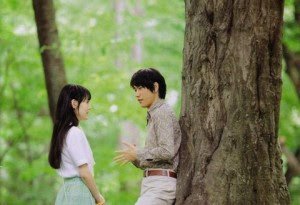
Rinko Kikuchi and Ken'ichi Matsuyama star in Anh Hung Tran's exquisitely photographed Norwegian Wood.
I have not seen either of filmmaker Anh Hung Tran’s famed works from the 1990s, The Scent of Green Papaya and Cyclo, but based on Norwegian Wood, I need to play catch-up very soon. Adapted from a novel by the legendary Haruki Murakami, whose work has long been considered un-filmable, the movie’s narrative isn’t the most cohesive, nor does it conjure up a conventional interest in the outcome. But viewed as a series of moments, which accumulate in intensity, Norwegian Wood is powerful and consuming.
Tran’s ability to immerse the viewer in a scene, so much so that you often feel as if you are one with the film, is evident from the beginning. Not ten minutes into Norwegian Wood, 17-year-old Kizuki (Kengo Kôra) commits suicide by car exhaust, in a sequence that pulls no punches. Tran and cinematographer Ping Bin Lee (In the Mood for Love) excel at conveying claustrophobia, boxing the characters in with compositions that remain stationary for extended periods of time, only to finally move with great precision. The aesthetic beauty of the shots, fused perfectly with Johnny Greenwood’s haunting score, is superseded only by the emotional chaos housed within them.
Kizuki’s suicide is only the beginning of the story of Watanabe (Ken’ichi Matsuyama), Kizuki’s childhood best friend, who narrates as if looking back. After enrolling in college in Tokyo, Watanabe encounters Naoko (Rinko Kikuchi), Kizuki’s girlfriend, who is even more devastated over the loss than he is. They begin an intimate relationship of their own, but it far from healthy, steeped in their respective feelings of guilt and Naoko’s vulnerability. Even more so than that of the breathless suicide scene, the camerawork during Watanabe and Naoko’s first sexual experience is mind-blowing in its simultaneous formal command and emotional rawness.
Watanabe’s story complicates even further when Naoko’s mental state becomes so fragile that she must leave for a sanatorium, while he enters another complicated relationship with classmate Midori (Kiko Mizuhara). Compelling as the film’s style is, the acting becomes the standout from this point on. Watanabe proves something of an enigma, but actor Matsuyama expertly plays every layer that the viewer peels back. And Kikuchi, who seemingly vanished after her critically acclaimed performances in Babel and The Brothers Bloom, is even more impressive, embodying mental illness and depression in a way that feels devastatingly authentic.
That said, Norwegian Wood is always so caught up in the emotions from scene to scene–the way the audience connects with the characters on an intimate level–that it ultimately lacks a clear thesis. The severity of the emotions mounts, reaching a crescendo that certainly feels profound, but what Tran wants the film to say on an external level (if anything) is unclear. Furthermore, I’m all for individual interpretation, but Tran doesn’t even leave viewers much to interpret; instead, he gives us an experience that is stimulating, but not particularly thought-provoking. That is not to say that said experience is not an accomplishment unto its own–Ping Bin’s cinematography and Kikuchi’s performance represent the best of the year in their respective categories–but rather that the whole of Norwegian Wood never quite matches up to the greatness of its individual elements. 3 Buckets out of 4. Screens again tonight, Oct 25, at 7:45 p.m. and on Fri, Oct 28, at 9:40 p.m.
2,000 words later and that’s a wrap on my coverage of the second day I spent at SDAFF 2011. I will post a lot more over the course of the week — next up, reviews of Ocean Heaven starring Jet Li, the Korean box-office hit Hello Ghost, and Centerpiece selection Surrogate Valentine!