
FROM THE BUCKET REVIEWS ARCHIVE
SDAFF 2011: Ocean Heaven, Hello Ghost, Eternity, My Wedding and Other Secrets, & Jiro Dreams of Sushi
Danny Baldwin · November 2, 2011
 The 2011 San Diego Asian Film Festival wrapped up Friday with a bang, as the Closing Night Feature, Jiro Dreams of Sushi, succeeded twofold: it turned the UltraStar Mission Valley into a raving madhouse (I could barely move about the lobby as I waited for the encore screening) and it was also a legitimately great movie, worth enduring the crowds for. I apologize for being a bit behind on my coverage — long days at the festival, plus preparation for AFI Fest (beginning Friday), have left me nary a spare moment to write. But perhaps waiting was a good thing, because I am now able to announce that, today, the festival honored the documentary The Power of Two (unseen by me) with its prestigious Audience Award. Without further adieu, here are my final five reviews for SDAFF 2011…

Jet Li and Wen Zhang star in Ocean Heaven.
Ocean Heaven (Xiao Lu Xue, China, 2010). While the majority of the American press has rightfully trumpeted Jet Li’s first non-action-based role as a cancer-stricken father struggling to secure proper care for his autistic son in the event of his death, they should be focusing even more on the young actor who plays said son, Wen Zhang. Unless you have watched recent Chinese television, you won’t have ever seen Wen, and his performance as Dafu feels so accurate, you are likely to believe that he is autistic in real life. But the truth is that he is just a talented actor who seized the opportunity to play a type of character rarely depicted on film (probably because it’s so hard to credibly play). Dafu was the make-or-beak element of Ocean Heaven, in that the viewer never would have been able to feel the paternal anguish of Li’s Old Wang had they not believed the story to begin with. Thanks to Wen, there is never any question of authenticity and the film’s overarching richness is able to shine through.
Outside of Wen and Li’s performances, the most admirable thing about Ocean Heaven is that it largely sidesteps ornate melodrama. I say ‘largely’ because the first scene finds Old Wang attempting to drown himself and Dafu, because he feels that death will be easier for Dafu than navigating life without his father. However, once the movie settles into its decidedly understated rhythm, which mostly consists of everyday events at the aquarium where Old Wang works, one begins to wonder whether the opening was supposed to be read literally in the first place. That’s how modest Ocean Heaven is with its drama; even though it is no doubt intended to be an old-fashioned weepy, writer/director Xue Xiaolu (who also wrote another excellent father-son film, 2002’s Together) keeps the events firmly grounded in reality. Only once the movie reaches its third act does the viewer feel the orchestrated pulling of their heart-strings, and this is perfectly welcome given the realness of what has come before. Rounded out by Christopher Doyle’s (Hero, The Limits of Control) handsome cinematography and Miyazaki-composer Joe Hisaishi’s swooping score, Ocean Heaven proves both technically sound and emotionally involving. The film has been picked up for U.S. distribution by the tiny company Well Go; hopefully, they will release it sooner rather than later. 3-1/2 Buckets out of 4.
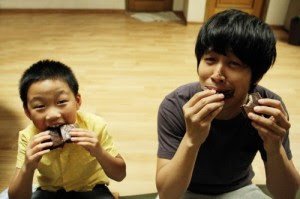
Bo-geun Cheon and Tae-hyun Cha indulge in sweets at the boy ghost's request in Hello Ghost.
Hello Ghost (Young-Tak Kim, South Korea, 2010). Thanks to a government policy mandating that a certain percentage of releases exhibited in the country be native productions, South Korea has developed a film industry that thrives both artistically and financially. Given the Koreans’ impeccable track-record delivering festival favorites over the past five years–you have seen Secret Sunshine and The Chaser by now, right?–it comes as a serious disappointment that both of their SDAFF submissions, the previously reviewed GLove and the box office hit Hello Ghost, proved mediocre.
The viewer meets Hello Ghost protagonist Sang-Man (Cha Tae-hyun) as he fails at a suicide attempt, only to awake in the hospital and discover that he can suddenly see ghosts. Four of them, to be exact — an alcoholic old man, a smoking taxi driver, a cowering woman who he finds in a metal closet, and a precocious little boy. That may sound like a great premise for a dark comedy, but the film’s tone is largely silly and whimsical, not sardonic. The ghosts follow Sang-Man around for the rest of the film, and he even allows them to take control of his body if they promise to go away in return. Their misadventures lack purpose and feel incredibly one-note, as Cha is not an especially likable protagonist and the ghosts are cartoonish caricatures. Writer/director Kim Young-Tak tosses in a romantic interest for Sang-Man to spice things up, as if he realized the sugar-coated monotony of it all, but this falls equally flat. Hello Ghost’s unexpected final revelation, which explains who the ghosts are and their significance to Sang-Man, is seriously clever, even moving, but all it does is prove that Kim has the capacity to be inventive, making the rest seem even worse. Hopefully Harry Potter’s Chris Columbus is able to enliven the concept when he remakes the film for U.S. audiences in 2014. 2 Buckets out of 4.

A confounding, but transfixing shot early in Eternity.
Eternity (Sivaroj Kongsakul, Thailand, 2010). The average multiplex-goer need not consider Eternity, which moves even slower than the already alienating works of Thailand’s most renowned modern filmmaker, Apichatpong Weerasethakul. But for those who are open to new cinematic experiences, the film is a real treasure. Through a triptych format, it chronicles a man’s (Wanlop Rungkumjad) life over no less than the eternity promised by the title — from the time he was young, falling in love with the woman who would become his wife (Namfon Udomlertlak), to his afterlife as a spirit. For as metaphysical as the premise is, director Sivaroj Kongsakul allows the events to unfold in real time, creating an everyday rhythm that invites the viewer to relate, provided they don’t actively resist the slow pace (as most ‘laymen’ unfortunately will). In fact, Eternity is the perfect reminder that the raw emotions surrounding love, life, and death don’t need to be dressed up in a dramatic narrative to be poignant. And I would be remiss not to mention that cinematographer Umpompol Yugala’s painterly compositions are a marvel to gaze at and digest over long takes, endowing the central romance with an ethereal beauty. For my money, Externity one of the finest romances of the year. 3 Buckets out of 4.

Look at the hap--, ahem, secret couple in My Wedding and Other Secrets.
My Wedding and Other Secrets (Roseanne Liang, New Zealand, 2011). It’s the same old story–traditionalist foreign parents disapprove of their daughter’s white boyfriend (or, in this case, unannounced husband)–but it’s handsomely made, with a Kiwi twist no less. Filmmaker Roseanne Liang is a better director than she is a writer, which is probably preferable to the other way around, because keeping the pace brisk and the tone uplifting is an absolute must in ensuring that viewers aren’t overly pained by the conventionality of the rom-com premise. But the real selling points are the leads, who imbue life into otherwise one-dimensional characters. Michelle Ang plays Emily, a university student who majors in computer science to please those Chinese parents, but is actually interested in studying filmmaking. The role could have easily descended into the usual rebellious offspring angst, but Ang instead opts for infectious vigor when she isn’t immediately involved in the central conflict. Likewise, Matt Whelan strays from the norm as Emily’s secret husband, giving the character a firm sense of frustration in his wife’s disapproving parents rather than the usual desperation for their acceptance. My Wedding and Other Secrets ends predictably, like every other picture in the genre, and even its most interesting elements don’t necessitate viewing, but if it ends up on Lifetime someday, you’ll have struck lazy afternoon gold. 2-1/2 Buckets out of 4.
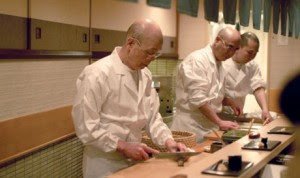
It's a normal day at the office for the title subject of David Gelb's exquisite Jiro Dreams of Sushi.
Jiro Dreams of Sushi (David Gelb, USA, 2011). It is a common piece of filmmaking wisdom that a great documentary should show viewers a world that they would never have encountered in their everyday lives, and Jiro Dreams of Sushi does exactly that. The title subject is an 85-year-old Tokyo sushi chef whose delicate touch and taste for his cuisine has made him a world-renowned Michelin award-winner, even though his restaurant only seats 10.
Director/cinematographer David Gelb indulges in the aesthetic beauty of each course that Jiro assembles, making the film a mouthwatering experience, even if you don’t eat sushi (I don’t). But Jiro Dreams of Sushi is about so much more than Jiro’s $300+ meal — it’s about the value of a strong work ethic (Jiro never takes a day off), the traditional order of Japanese families (Jiro trains his eldest son to take over the business, while his younger son starts his own sushi restaurant), and how incredibly passionate someone can become for what may seem like a mundane, mechanical trade on the surface. Even at a tight 82 minutes, Gelb packs as many rich themes into the film as there are flavors in Jiro’s precise, honed delicacies. (Speaking of which, you will hardly believe how steep the learning curve for his prep cooks is.)
For as idea-filled as Jiro Dreams of Sushi is, however, it never loses its sense of humanity. We don’t know a lot about Jiro’s past other than that he was kicked out of the house at age nine, during the Great Depression, and that this drove him to his craft. But Jiro’s admirable devotion is so distinctly human that it allows the viewer to forge a personal connection with him that makes the film feel intimate, sometimes poignant. Even if you don’t care the least bit about sushi, you will care about and look up to this master chef. For compelling filmmaking (from a first-time theatrical documentarian, no less) about a great subject, you will have a hard time finding better than Jiro Dreams of Sushi. 3-1/2 Buckets out of 4.
And that’s a wrap on my coverage of SDAFF 2011. I must say, my first experience at the festival could not have been better — the majority of the films I saw were worthwhile and the festival mechanics were impeccable (rarely did a screening start more than ten minutes late, a true rarity for this type of event). Thanks especially to the folks at the media desk–Dan Matthews and Diana Chow, plus countless volunteers–for taking care of us critics. I will certainly be back next year. Until then…