
FROM THE BUCKET REVIEWS ARCHIVE
Review: Point Blank
Danny Baldwin · August 19, 2011
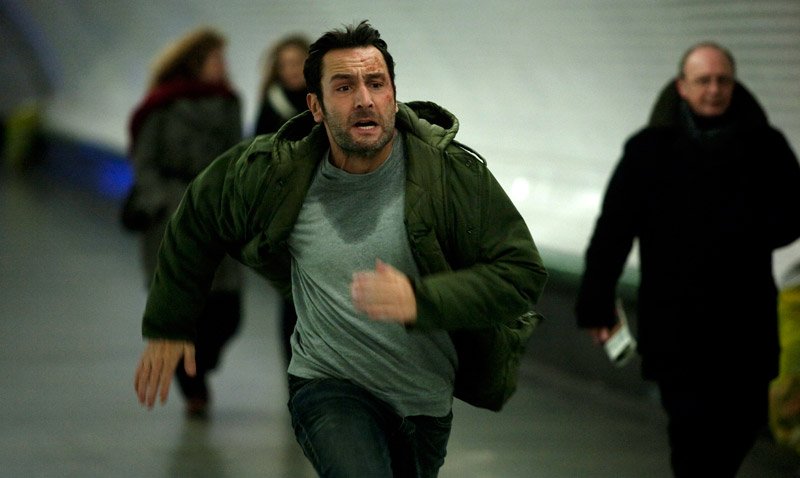
 If there is one thing to admire about Point Blank, it is that the movie is a true meat-and-potatoes action flick, trimmed of all fat to a whip-snap 84-minute running time. Co-writer/director Fred Cavayé is supremely confident in the material, absent the amateurish desire to provide unnecessary subplots or character quirks to make the proceedings feel more substantial. And just as his story is welcomely stripped-down, so too is his aesthetic — for a documentary-style chase movie, Point Blank keeps the shaky-cam shots tasteful and shows no fetish for zooming.
The major problem with the film is that, despite its admirably pure take on a usually bloated formula, it’s still a formulaic piece of work nonetheless. If you’ve seen a Liam Neeson movie lately, you’ll probably be tired with Point Blank before it even begins. The Neesonesque protagonist is Samuel Pierret (Gilles Lellouche), an average Joe who works as a nurse at a Paris hospital. Making the rounds one night, he finds gangster patient Hugo Sartet (Roschdy Zem) suddenly on the verge of cardiac arrest, apparently poisoned by an intruder. Samuel is able to stabilize Sartet, but not without consequence.
The next day, Samuel comes home from work and Sartet’s men are waiting in his apartment. They smack him unconscious and, by the time he wakes up, they have taken his bedridden, pregnant wife hostage. To get her back, Samuel must help Sartet escape from the hospital, where the police are now monitoring him. Because notifying the cops of his predicament, as always, out of the question, Samuel has little choice but to team up with Sartet, clearly a violent gangster who is up to no good. Nothing screams inherent drama like an unborn child in turmoil.
While we don’t know exactly how the twists and turns of the plot will take place, we know their ultimate outcome because we’ve seen this movie dozens of times before. For being perceptive enough to recognize that the aforementioned subplots and character quirks couldn’t solve this problem, Cavayé should have been smart enough to realize his time was better spent making a more original film.
But at least Point Blank is short and lean enough that it never seems like an endurance test, as its American equivalents often do. It opens with an adrenaline-pumping, staircase-based action set-piece and never lets up from there. Furthermore, the acting is reasonably involving; Lellouche may not be as charismatic as Neeson because he never transforms into a Herculean vigilante, but he does the ‘ordinary guy responding to extraordinary circumstances’-archetype proud. Zem does the same for the role of ‘slimy gangster with questionable allegiances.’
With any luck, we’ll see Cavayé come out with a better movie in a couple of years and be able to chalk this one up as a practice run-through of filmmaking elementals. The only other notable credit on his resume is writing the original draft (in French) of last year’s superior Russell Crowe action-drama The Next Three Days. Perhaps that will allow him to break into the American industry — an exciting proposition because, even though Point Blank is not a great movie, Cavayé’s directorial chops are clearly better than 90% of our country’s action filmmakers.
* * *
Point Blank (2011, France). Produced by Jeremy Burdek, Cyril Colbeau-Justin, Serge de Poucques, Jean-Baptiste Dupont, David Giordano, Sylvain Goldberg, Nadia Khamlichi, Adrian Politowski, and Gilles Waterkeyn. Directed by Fred Cavayé. Written for the screen by Fred Cavayé and Guillaume Lemans. Starring Gilles Lellouche, Roschdy Zem, Gérard Lanvin, Elena Anaya, Mireille Perrier, and Claire Perot. Distributed by Magnolia Pictures. Not rated (acceptable for teens), with a running time of 84 minutes.