
FROM THE BUCKET REVIEWS ARCHIVE
AFI Fest 2011: The Color Wheel, Green, Jiro Dreams of Sushi, & Kill List
Danny Baldwin · November 4, 2011
 Los Angeles’ annual AFI Fest officially kicked off yesterday evening with the red carpet premiere of Clint Eastwood’s J. Edgar, starring Leonardo DiCaprio, but the festival begins in earnest tonight. Normally, with this type of event, I write a preview detailing all of the films that I am most looking forward to, but the lineup here is simply too expansive and too strong across-the-board to follow that routine. (Plus, there’s no way I could do any better than LA Weekly’s piece on the festival’s 35 “must-sees,” found here.) Furthermore, for the third year in a row, all the tickets are free–most have already been reserved, but there are still some available for select shows at the fest’s website and you can always try your luck at the rush line–so you don’t have much to lose by seeing everything that you can. I had the opportunity to watch four films playing at AFI Fest in advance, and there is no better time than now to give you all the lowdown…

Carlen Altman delivers a terrific, alternately comic and dramatic performance in Alex Ross Perry's The Color Wheel.
The Color Wheel (Alex Ross Perry, 2011, USA). As with Sophia Takai’s Green (reviewed below), it is tempting to liken this small film to those of the mumblecore movement, what with its micro-budget and unassuming story. However, The Color Wheel has far more character definition and thematic purpose than the usual mumblecore movie, with the exception of the superior works of the Duplass Bros. The premise is simple: adult siblings Colin (co-writer/director Alex Ross Perry) and J.R. (Carlen Altman) take a road trip en route to the home of J.R.’s now ex-boyfriend, who was also her college professor, to move her stuff out. J.R. has clearly been somewhat estranged from her family in recent years, and the brother and sister’s interactions are laced with tension. But Colin and J.R. still share great familial chemistry, as reflected in their mile-a-minute dialogue exchanges, which allow the leads to forge engaging, distinct personalities. And contrary to the usual road trip mold, which follows prefabricated beats, Perry crafts an honest, spontaneous look at the nature of sibling relations, which are often as complicated as they are inextricable. The black-and-white 16mm cinematography is another nice anti-establishment touch because it forces the viewer to not become side-tracked by the usual visual distractions of a road-trip, isolating the emotional meat of each scene. The only downside–and it’s considerable–is that these characters aren’t particularly likable, making it hard to care about what happens to them. While I enjoyed their presences during the more comical scenes–the duo’s encounter with a creepy, Bible-thumping motel clerk is priceless–I found myself viewing the bulk of the movie from an externalized frame, concerned with theme over character. Nonetheless, I look forward to what Perry does in the future, because there’s a lot of promising talent on display in The Color Wheel. 2-1/2 Buckets out of 4. Screens Sat, Nov 5 at 10:30 p.m. and Mon, Nov 7 at 1:15 p.m.

Sophia Takai and Kate Lyn Sheil share a scene in Green.
Green (Sophia Takai, 2011, USA). Green was made by many of the same folks as The Color Wheel–Perry even has an early cameo–and is also about emotions that boil under the surface of a relationship (in this case, a couple rather than siblings), but it is a considerably different movie. While Colin and J.R. often mask their problems with inconsequential dialogue, Genevieve (Kate Lyn Sheil) and Sebastian (Lawrence Michael Levine) experience their developing rift largely in silence. The opening of Green sees the couple move from New York City to a rental in the Virginia countryside so that Sebastian can find artistic inspiration in farming. There, they meet neighbor Robin (writer/director Sophia Takai), an obtuse Southern stereotype, whose presence quickly becomes threatening for Genevieve, driving her to become paranoid about the possibility of her husband’s eyes wandering. Actor Kate Lyn Sheil is the best part of the equation, delivering an intrinsic, increasingly tortured performance that creeps up on the viewer and forces them to really consider the character. How well Takai’s directorial approach works is up for debate–I personally found her overarching images of nature (inferred by the title) overly arbitrary in the way they accentuate the film’s primal aspects–but the performances and effectively minimalist writing compensate. Even if the film doesn’t illicit the most personal response, most will find it intriguing as a slow-burn character study. 2-1/2 Buckets out of 4. Screens tonight at 5 p.m. and Saturday, Nov 5 at 10 p.m
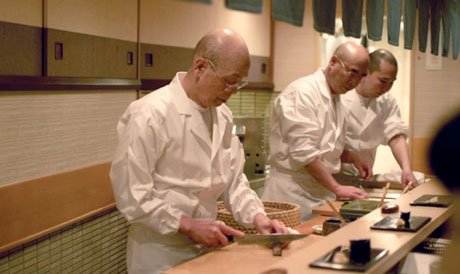
It's a normal day at the office for the title subject of David Gelb's exquisite Jiro Dreams of Sushi.
Jiro Dreams of Sushi (David Gelb, 2011, USA). [Reprinted from my SDAFF ’11 coverage:] It is a common piece of filmmaking wisdom that a great documentary should show viewers a world that they would never have encountered in their everyday lives, and Jiro Dreams of Sushi does exactly that. The title subject is an 85-year-old Tokyo sushi chef whose delicate touch and taste for his cuisine has made him a world-renowned Michelin award-winner, even though his restaurant only seats 10.
Director/cinematographer David Gelb indulges in the aesthetic beauty of each course that Jiro assembles, making the film a mouthwatering experience, even if you don’t eat sushi (I don’t). But Jiro Dreams of Sushi is about so much more than Jiro’s $300+ meal — it’s about the value of a strong work ethic (Jiro never takes a day off), the traditional order of Japanese families (Jiro trains his eldest son to take over the business, while his younger son starts his own sushi restaurant), and how incredibly passionate someone can become for what may seem like a mundane, mechanical trade on the surface. Even at a tight 82 minutes, Gelb packs as many rich themes into the film as there are flavors in Jiro’s precise, honed delicacies. (Speaking of which, you will hardly believe how steep the learning curve for his prep cooks is.)
For as idea-filled as Jiro Dreams of Sushi is, however, it never loses its sense of humanity. We don’t know a lot about Jiro’s past other than that he was kicked out of the house at age nine, during the Great Depression, and that this drove him to his craft. But Jiro’s admirable devotion is so distinctly human that it allows the viewer to forge a personal connection with him that makes the film feel intimate, sometimes poignant. Even if you don’t care the least bit about sushi, you will care about and look up to this master chef. For compelling filmmaking (from a first-time theatrical documentarian, no less) about a great subject, you will have a hard time finding better than Jiro Dreams of Sushi. 3-1/2 Buckets out of 4. Screens Tue, Nov 8 at 4:30 p.m. and Wed, Nov 9 at 7:15 p.m.
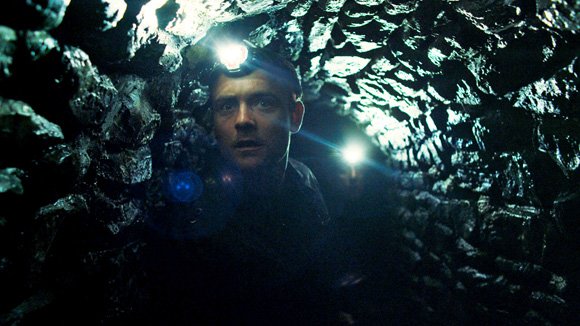
Neil Maskell stars in Ben Wheatley's ultimately wrongheaded, offensive Kill List.
Kill List (Ben Wheatley, 2011, UK). Because I saw the film in a private screening with under a dozen fellow journalists, I can’t attest to whether its “WTF!?”-breed of narrative trickery plays better with a loud Midnight audience. But I can say that, by itself, Kill List is of little merit. After a dinner party sequence that finds main character Jay (Neil Maskell) in a puzzlingly unstable state of mind, the movie becomes a fairly standard, albeit incredibly brutal tale of hit-men carrying out a high-stakes job. Jay and partner Gal (Michael Smiley) follow the ‘kill list’ provided to them by an illusive client, crossing the names off one by one. There are clues that things are not what they seem–references to a past job gone wrong, a hit who claims that he knows Jay before he stares into the barrel of the gun, etc.–and the backstory is often kept intentionally vague, but few viewers will expect the absolute 180° mind-fuck that co-writer/director Ben Wheatley (Down Terrace) pulls in the final act. In fact, you’re lucky to make sense of the experience even days after you see it.
That may sound great on paper, but Kill List becomes morally reprehensible in the final twist, which reframes all the explicit violence that has come before as part of a glorified audience guessing game. I won’t spoil what happens for the poor souls who remain committed to enduring the film, but I will say that Wheatley ultimately takes things in a campy direction that makes the graphicness of what has come before unjustifiable. If they knew it was camp from the start, most viewers would be reviled by the entire picture.
Furthermore, you know a movie doesn’t have much to offer when it obscures major story points simply so that it can later reveal them, shocking viewers rather than stimulating them. The only wholly commendable elements of Kill List are the gritty widescreen cinematography by Laurie Rose and the credible lead performances by Maskell and Smiley, which are ultimately rendered useless by Wheatley’s sorry antics. Some will no doubt get a kick out of Kill List’s confounding final turn, but only because they are naïve and/or inebriated enough to be impressed by narrative manipulation over actual substance. 1 Bucket out of 4. Screens Sat, Nov 5 at Midnight and Sun, Nov 6 at 8 p.m..
That’s all I have for now, but stay tuned for more updates and reviews as AFI Fest 2011 kicks into gear. Let the moviegoing begin.