
FROM THE BUCKET REVIEWS ARCHIVE
Danny Baldwin’s Favorite Films of 2011
Danny Baldwin · 2011 · Inferred archive year; publication date unknown
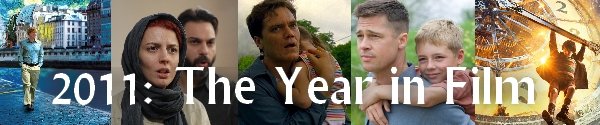 If there was a prevailing theme at the cinema in 2011—aside from the box office decline, which was vastly overstated, anyway—it was thematic dreariness. That’s not to say that the movies weren’t good (they were), but rather that there hasn’t ever before been a year of so many depressing releases, at least in my lifetime. 2011’s big ticket awards contenders include George Clooney coping with a comatose wife who cheated on him, Michael Fassbender self-destructing via sex addiction, a WWI cavalry horse enduring bloody blows, a kid mourning the loss of his father on 9/11, and a certain girl with a dragon tattoo getting raped.
You could find quality uplift if you sought it out—in fact, several “happy” films appear on my top 10—but this often wasn’t easy. For as overrated as The Artist, the current frontrunner for Best Picture, may be, its crowd-pleasing nature is a godsend in light of its competitors. And while the bulk of cheery Hollywood blockbusters lacked panache, there were a few highlights: The Green Hornet, Arthur, Bridesmaids, Crazy Stupid Love, Footloose, and A Very Harold and Kumar Christmas (who would have predicted I would finally come around to the stoner comedy franchise?).
That being said, when it came to make my year-end top 10, I put my growing intolerance for dark material aside. All of the movies that appear on the following list earned whatever emotions they evoked in me. Without further ado…
Danny Baldwin’s Favorite Films of 2011 (listen to the podcast version of this list)
Honorable Mentions: 50/50, Harry Potter and the Deathly Hallows: Part Two, The Interrupters, Meek’s Cutoff, Moneyball, and Tinker Tailor Soldier Spy.
10. Contagion – Steven Soderbergh’s supreme level of directorial precision is just what Scott Z. Burns’ script about a devastating global pandemic needed to feel credible. The film humanizes its ensemble—with so many of Hollywood’s finest actors, it would be silly not to—but it also understands that their emotions are not what will stay with the viewer. The fear that the pandemic could actually happen, just as Soderbergh depicts it, will. |
9. Le Quattro Volte – To call Michelangelo Frammartino’s visual exploration of Pythagorean transmigration—from human to animal to vegetable to mineral— “hypnotizing” and “poetic” would be true, but such glib adjectives disservice the breadth of the work. It’s a meditation on life and death, but it’s more spontaneous than you’d expect of such – almost postmodern despite its ancient roots. |
| 8. Young Adult – Director Jason Reitman and writer Diablo Cody reteam for the first time since Juno, the breakthrough that put them on the map, and the new film is very different but equally satisfying. This time, they tackle the comic antihero with Charlize Theron’s Mavis Gary, who leaves the film as unredeemed as she enters it – a ballsy choice in contemporary Hollywood. Theron thoroughly commits to her tough role, as supporters Patton Oswalt, Patrick Wilson, and Elizabeth Reaser do theirs. |

7. The Skin I Live In – After making several comparatively serious melodramas, legendary Spanish auteur Pedro Almodóvar has returned to the more darkly funny, shockingly absurdist version of the genre he popularized in the late ‘80s and early ‘90s. Almodóvar revisits his favorite images and social constructs—flesh, gender, madness, dysfunctional families, etc.—but the material nonetheless feels as fresh as ever. Antonio Banderas is commanding as the insane protagonist, and the cinematography and production design are so vibrantly beautiful you might wish film stock were edible. |
6. Martha Marcy May Marlene – A star is born in Elizabeth Olsen, who plays a cult survivor failing to readjust to normal life. The film is a deconstruction of the genre—it begins as Martha escapes the cult, not as she is lured in—and consistent with such, Olsen’s performance dares to explore the realities of her character, not the typical Hollywood clichés. Her disconnection and paranoia consume the audience. John Hawkes is also tremendous as the charismatic leader of the cult, seen in flashbacks. |
5. A Separation– Asghar Farhadi’s film of intertwining domestic dramas is set distinctly in the male-controlled society of Iran, but it is structured in such a way that it forces the viewer to consider the perspective of each character, making it a relatable human experience even for Westerners. The way that Farhadi is able to pack so much—the weight of daily life under a theocracy, the familial divisions caused by child custody cases, the struggles of caring for an elderly parent, the questionable objectivity of legal systems, etc.—into such a focused film is a significant accomplishment. The acting—especially Peyman Maadi as the stubborn patriarch—is just as good as the filmmaking, capturing the characters’ alternating feelings of certainty and doubt. |
| 4. The Tree of Life – If Farhadi’s ability to pack all of A Separation into two hours was a feat of economy, then Terrence Malick’s fusion of the birth of the entire universe and the 1950s childhood of the protagonist in The Tree of Life, which runs a mere 15 minutes longer, was no less than a miracle. The movie has its flaws—as emotionally overwhelmed as I was during the Sean Penn bookends, I still don’t think they click with the rest—but these are to be expected of a work of such great scope and ambition. A full interpretation of the film and its myriad of themes is not a task for this piece; instead, I will merely submit that no film this year left me with as many thoughts and feelings as this one did. It is that rare cinematic achievement that feels both personal and fully realized. Needless to say, every performance and technical element is ace. |

3. Midnight in Paris – Not only is it Woody Allen’s best film in nearly two decades, but its ultimate critique of “Golden Age Syndrome” feels like Allen’s personal resolution to stop trying to recreate past glories and make new inventions instead. And what an invention Midnight in Paris is – for as prototypical an Allen protagonist as Owen Wilson plays, the story itself is among the year’s most original. Roaming the streets of Paris, Wilson’s disillusioned Hollywood screenwriter discovers time-travel, enabling him to congregate with 1920s art heroes like Ernest Hemingway, F. Scott Fitzgerald, and Pablo Picasso. Remarkably, the icons are played with just as much depth as the fictional characters, giving the picture unexpected historical/cultural weight. And Wilson’s budding romances—both in the past, with Marion Cotillard, and in the present, with Léa Seydoux—are thoroughly swoon-worthy. Midnight in Paris is that rare romantic-comedy that is actually both romantic and comical. |
2. Hugo – Martin Scorsese preserves the film medium’s past while re-inventing it for the future – through a family movie, no less. The key idea that the master filmmaker understands and demonstrates here is that, for all that the medium physically changes—Hugo was shot on digital cameras in 3-D—the elementals of good storytelling do not. That is, for as revolutionary as the movie looks and feels—this is the best use of the “extra dimension” to date—it still attempts the same sense of magic that the silent film pioneer Georges Méliès (one of its characters) achieved over a century ago. Cinephiles are liable to shed a few tears by the end, for Scorsese’s ability to fuse humanism and film history is as profound as it is uncanny. But Hugo is truly a movie for everyone – the old-fashioned adventure, the lavish production design, and the seamlessly integrated historical allusions make for the best Hollywood production of the year. |
1. Take Shelter – The best film of 2011 is also the most criminally under-seen. Blue-collar, Midwestern father Curtis LaForche is either developing paranoid schizophrenia or accurately prophesizing the apocalypse – a binary that could have all too easily become fodder for hokey metaphor. But with writer/director Jeff Nichols and actor Michael Shannon at the helm (their second film together, following 2007’s Shotgun Stories), Curtis becomes the most authentically human character of the year. He may be the symbolic fulcrum for a plethora of dense themes—the pervading feeling of loss of control among modern Americans, the vitality of the family, the inadequacy of American mental health services, the fine line between madness and brilliance—but he is nonetheless a man. Foreign as his specific fears may strike the viewer, Curtis’ underlying sense of anxiety is imminently relatable, often poignant – an encapsulation of the zeitgeist. And for as much gloomy ambiguity as there is in Take Shelter, the final shot resonates with resolute thematic assurance, whatever one’s interpretation of the protagonist’s mental state. Shannon delivers the performance of the year, and Jessica Chastain is equally integral to the film’s success as his committed wife. See this movie. |
Filed under Columns / Blogs
Tags: 2011: The Year in Film, A Separation, Academy Awards, Contagion, Hugo, Le Quattro Volte, Martha Marcy May Marlene, Midnight in Paris, Oscars, Take Shelter, The Skin I Live in, The Tree of Life, Top 10 films of 2011, Top 10 lists, Top 10 movies of 2011, Top 10 of 2011, Young Adult