
FROM THE BUCKET REVIEWS ARCHIVE
Review: Midnight in Paris
Danny Baldwin · June 2, 2011
 Midnight in Paris has been universally pronounced Woody Allen’s new millennium comeback by critics (who have seemingly forgotten about their beloved Match Point and Vicky Cristina Barcelona, perhaps because they were less typical of the filmmaker’s oeuvre). It’s easy to see why, for the movie stands Allen’s most realized and ‘complete’ romantic-comedy in over a decade. In other words, he replaces the unrestrained neuroses-based approaches of Hollywood Ending, Anything Else, Melinda and Melinda, and others with rounded-out themes and a more traditional narrative structure. I actually like a great deal of those films deemed inferior–there are far worse things than spending two hours in Allen’s frantic head–but I understand the criticism that they often feel like caricatures of his older work. More than Allen’s rediscovered grace for storytelling, this is the area in which Midnight in Paris establishes that it is the product of a writer/director who’s still got it: the movie feels fresh. Yes, on a personal level, I still may prefer the all-over-the-place Anything Else, but I’m elated that one of my favorite living filmmakers has once again made a movie for all to enjoy.
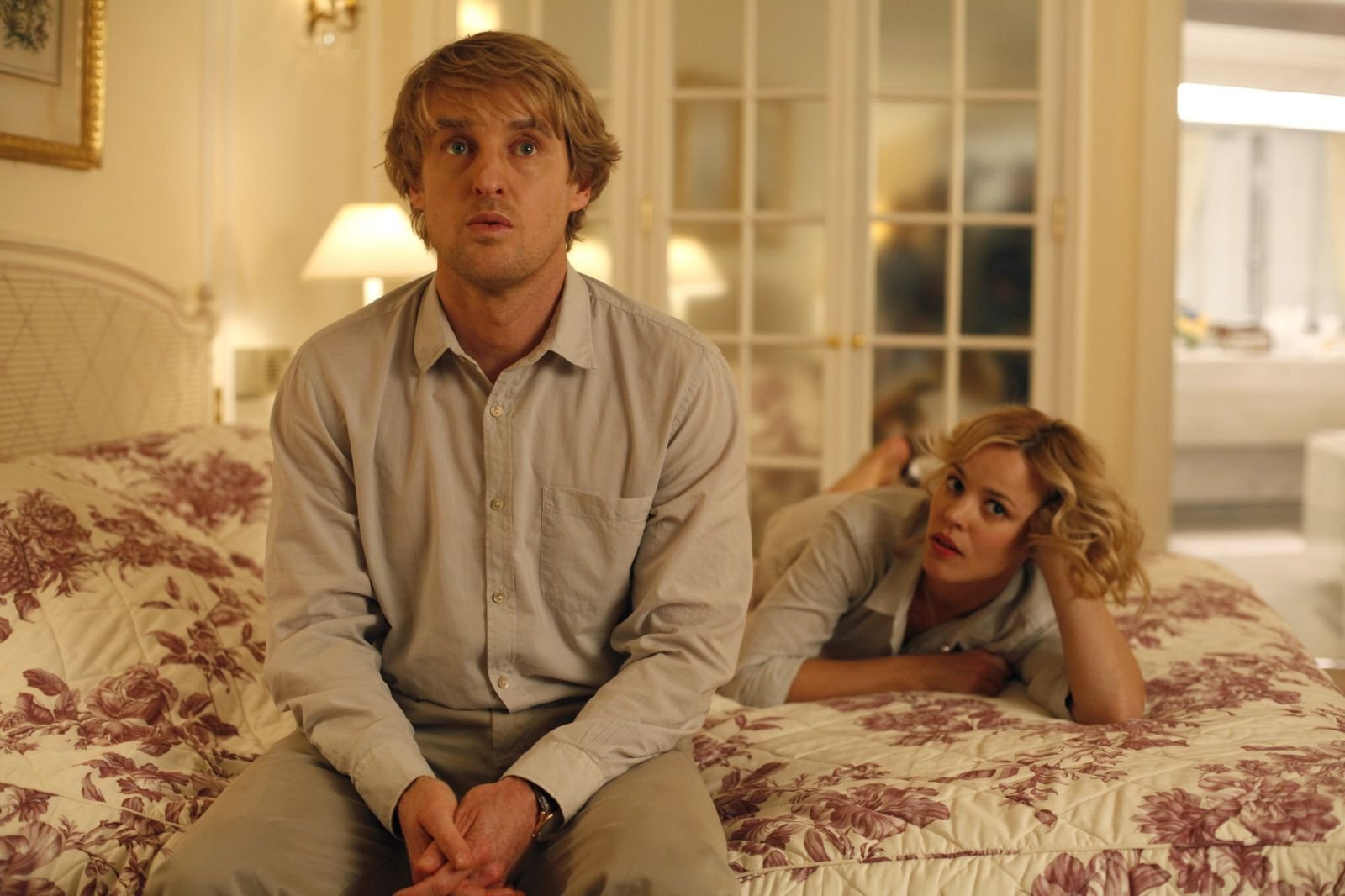
This time around, Allen uses Owen Wilson as the conduit for his traditional outsider protagonist (he hasn’t played the role himself since 2002). The pairing is surprisingly effective. At first, you wouldn’t think that the laid-back, steady-toned Wilson would have the ability to channel Allen’s trademark anxieties, but he creates a perfect California version of the estranged artiste. In fact, his naturally mild manner doesn’t interfere with the inherent neuroses of the character at all. The proof is in the pudding: when his foil (fianceé Inez, played by Rachel McAdams) tells him he shouldn’t stay pent up in their Paris hotel because he’ll spend too much time obsessing over the fire exits, it totally gels with Wilson’s characterization.
In fact, the movie is the perfect showcase of varied acting from an Allen ensemble because of its time-spanning story, which despite its classicism is Allen’s most ambitious in years. Wilson’s Gil, clearly about to marry the wrong woman (this is the only movie you’ll ever see in which McAdams will seem unsexy), roams the streets of Paris in search of inspiration, as he dreams of abandoning his successful Hollywood screenwriting career to become a novelist. All too often, Gil’s vacation is interrupted by Inez’ former professor Paul (an hysterical Michael Sheen), who bumps into them by happenstance and decides to use the opportunity to culture them with wine-tastings and museum tours, over which he provides scholarly commentary that is often made up.
That is, until one night, when Gil discovers that at the strike of midnight, something magical happens. He is picked up on a random street corner by an old-fashioned car, which drives him right back to the 1920s. There, he socializes with his literary heroes, from F. Scott and Zelda Fitzgerald (Tom Hiddleston and Alison Pill) to Ernest Hemingway (Corey Stoll) to Gertrude Stein (Kathy Bates). He also meets the beautiful Adriana (Marion Cotillard), with whom he begins to fall in love. All of these performances, whatever their historical accuracy (I’ll leave that analysis to the literary fiends), are so, so good. They remind us that Allen, beyond being a writer, is a first-class director of actors, as his entire ensemble delivers.
I mentioned that the movie boasts superiorly realized themes compared to other recent works by Allen. Most prominent among these is the idea that the comfort of nostalgia often impinges on the contemporary artist’s ability to seize the day and make new art, in a perpetual cycle of romanticizing the past. Wilson’s Gil is not only afflicted by this syndrome, as he sits in awe of the 1920s gods he believes he could never match, but he writes about it self-reflectively in his attempted novel, which features a metaphorical ‘Nostalgia Shop.’ Without spoiling too much of the journey, I will say that the movie ultimately concludes that this is a highly destructive impulse, drawing a clear line between nostalgia and inspiration. It is no mistake, then, that Midnight in Paris represents Allen’s own letting go of his nostalgic sensibilities as a filmmaker. Enjoyable as they may have been for me (not coincidentally a very nostalgic person), it is true that most of his films from the last ten years have represented a sort of ‘re-living’ the glory days, adhering to a tired form. Midnight in Paris feels like Allen’s resolution to now push for something new and exciting every time he writes and directs — to not fear the unknown, even in a career as established as his. (Well, except for the usual jabs at conservatives, which are still cloyingly present.) At 75 years old, he has reaffirmed that he is still a force to be reckoned with in filmmaking, and there is really no greater gift he could have given audiences than that.
* * *
Midnight in Paris (2011, USA). Produced by Letty Aronson, Raphaël Benoliel, Javier Méndez, Helen Robin, Jack Rollins, Jaume Roures, and Stephen Tenenbaum. Directed and written for the screen by Woody Allen. Starring Owen Wilson, Rachel McAdams, Kurt Fuller, Mimi Kennedy, Michael Sheen, Nina Arianda, Carla Bruni, Alison Pill, Corey Stoll, Tom Hiddleston, Kathy Bates, Marion Cotillard, and Léa Seydoux. Distributed by Sony Pictures Classics. Rated PG-13, with a running time of 95 minutes.