
FROM THE BUCKET REVIEWS ARCHIVE
Review: The Names of Love
Danny Baldwin · July 14, 2011
 I’m a big believer in the notion of American exceptionalism, but even so, I recognize that there are a select few things that Americans aren’t able to accomplish that citizens of other countries are. One of these things is make a movie like The Names of Love: a romantic-comedy, sex farce, political satire, and exploration of how our ethnic backgrounds inform who we are, all wrapped into one. Can’t you just picture Ashton Kutcher and Jennifer Aniston in the lead roles? Yeah, I didn’t think so.
Who but the French could have gotten away with this movie? We must be eternally grateful that, instead of Kutcher and Aniston, we get the eons more versatile Jacques Gamblin and Sara Forestier. He plays Arthur Martin, a middle-aged veterinarian whose personal life is only eclipsed in dullness by the focus of his work: autopsying birds. She plays Baya Benbahmoud, a sexually ravenous twenty-something who sees it her duty to sleep with right-wing men in order to convert them to her socialist agenda. Miraculously, Baya’s unhealthily high need for arousal is not simply a cheap excuse to titillate the viewer with gratuitous shots of actress Forestier’s sumptuous body, but rationally explained by the story: Baya was molested as a girl by her piano teacher, hence the acting out as an adult.
Baya and Arthur meet, initially without the cute, which rest assured comes a little later in a sequence that finds Forestier roaming the streets and subways of Paris completely naked. Despite their difference in age and a clear lack of similarities–he isn’t even ‘fascistic’ enough to count as one of her usual subjects of seduction–Arthur and Baya hit it off. In their dysfunctional but nonetheless often sweet relationship, co-writer/director Michel Leclerc finds the fulcrum of his story. Yes, The Names of Love is in large part a movie about amour, but it’s far more complex than just that.
For one, it’s about how the places we come from–that is to say, the ethnic sources of our ‘names,’ per the title–inform the way that we interact as social beings. In the film’s opening, Arthur and Baya directly speak to the audience in voice-over, describing how they came to be, from the time their parents met to the present. Arthur is the product of a Jewish mother who escaped the Holocaust to France, where she married his father, who now runs a nuclear power plant but once served as a soldier in French Algeria. Coincidentally, Baya’s father is an Algerian immigrant, and his marginalized social status in France was probably a large part of why her lefty-activist mother clung to him. What does all this exposition mean? Not a whole lot of the cogent variety, but it provides bountiful insight into Arthur and Baya as characters, and it invites the viewer to contemplate the fascinating idea of how much of one’s personality is predetermined before they are even born, let alone an adult.
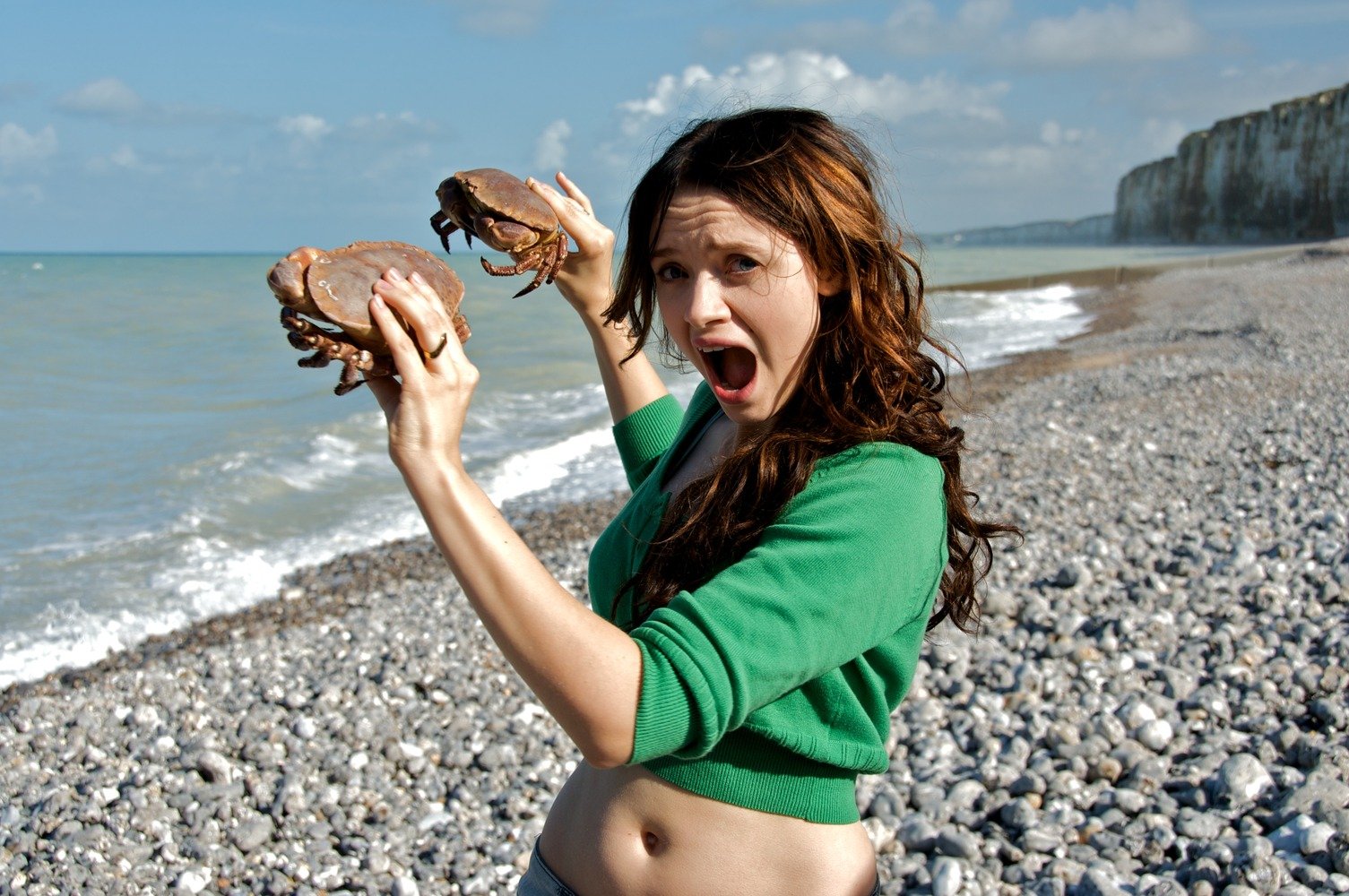
Abstract ideas that take the viewer on welcome intellectual tangents are indeed the strong suit of The Names of Love. This is further proven by its political satire, which lacks ideological consistency but is pretty darn amusing. Leclerc and co-writer Baya Kasmi’s script certainly seeks to poke fun of Baya the character as a personification of liberal guilt — not only does she use the stereotypically leftist tool of sex to convert adversaries; there is even an absurd scene in which she convinces Arthur to buy up crabs from the supermarket and release them back into the ocean. (Why not lobsters? Because crabs are cheaper than lobsters and, being that a crab’s life is equal to that of a lobster, she can save more lives by saving those of crabs.) But at the same time, the film often cheers Baya on in her political pursuits, as they are tonally characterized by the folly and idealism typically associated with glamorizations of leftism. There is even a gleeful cameo by the Socialist Party of France’s nominee in the 2002 Presidential Election, Lionel Jospin. But given that the movie’s political contradictions are hardly offensive, it is best to simply appreciate its stunning feat of engaging these ideas within the context of a romantic-comedy in the first place.
I’ve gone this far without praising The Names of Love for its obvious technical merits. Director Leclerc conducts the film with great economy, delivering the central romance and all its glorious baggage in a tightly wound 100 minutes. Vincent Mathias’ cinematography is ace, using a variety of film formats to great effect. And the lead performances are dead on; Gamblin fleshes out the boring-on-the-surface Arthur with great nuance as he travels a tumultuous journey with Baya, and Forestier is an unafraid powerhouse in a role that all too easily could have lent itself to the wrong kind of comedy. On the whole, The Names of Love may be too scattershot and frenziedly impassioned to reach filmic greatness, but it will no doubt serve as a welcome antidote to just about every domestic rom-com you’ll see this year.
* * *
The Names of Love (2011, France). Produced by Caroline Adrian, Franck Celton, Fabrice Goldstein, Véronique Hellot, and Antoine Rein. Directed by Michel Leclerc. Written for the screen by Michel Leclerc and Baya Kasmi. Starring Jacques Gamblin, Sara Forestier, Zinedine Soualem, Carole Franck, Jacques Boudet, Michèle Moretti, and Zakariya Gouram. Distributed by Music Box Films. Rated R, with a running time of 100 minutes.